Digital Catalog for Fashion Brands: Why It’s No Longer Optional in 2026
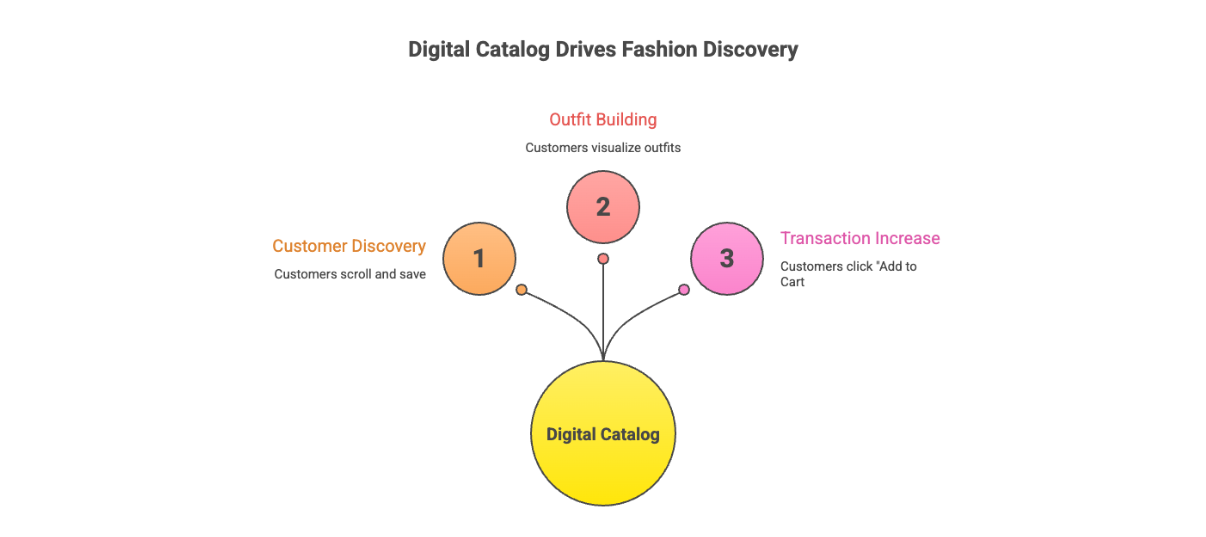
If you run a fashion brand today, you already know something important:
Your customers don’t shop the way they did five years ago.
They don’t land on a category page and calmly filter by “Blue Dress – Size M.”
They discover. They scroll. They save. They compare. They build outfits in their head before they ever click “Add to Cart.”
That’s exactly where a digital catalog comes in.
And no we’re not talking about a 30-page PDF.
In 2026, a fashion digital catalog is your discovery layer. If you're new to this format, understanding what a digital catalog is at a basic level will help clarify how it fits into a fashion brand's selling stack.
The Shift: From Product Grid to Outfit Story
Traditional ecommerce works like a warehouse.
Grid.
Filters.
Price.
Add to cart.
It’s efficient. But it’s emotionally flat. Fashion doesn’t sell on efficiency. It sells on feeling.
Modern fashion brands are using interactive digital catalogs often styled like lookbooks to recreate what used to happen in physical stores:
- Complete looks instead of isolated SKUs
- Fabric movement instead of static photos
- Mood, vibe, identity
Instead of showing a kurti, they show the entire festive edit. Instead of listing sneakers, they show the full street look. That shift changes behaviour. When customers see context, they buy combinations. When they see combinations, average order value increases.
Discovery vs Utility: Why Fashion Needs Both
There are two very different mindsets online.
One user types:
“Buy black bodycon dress under 2000.”
Another scrolls Instagram and thinks:
“This vibe is exactly what I want.”
The first mindset fits ecommerce grids. The second needs a digital catalog. Interactive lookbooks typically increase engagement time significantly because people explore, not just search. More time means more familiarity. More familiarity means higher buying confidence.
And fashion desperately needs that confidence. Return rates in fashion are among the highest in ecommerce often driven by fit, styling expectations, or mismatch between product and imagination.
The more context you provide upfront, the fewer surprises later.
What a Strong Fashion Digital Catalog Includes
A good fashion catalog today is not just pages of product shots.
It usually includes:
- Styled outfit compositions
- Short motion clips showing drape and fall
- Close-up fabric details
- Clear size and fit guidance
- Direct, seamless path to purchase
The goal isn’t to overwhelm. It’s to guide. When done properly, it feels like browsing a curated edit not scanning inventory.
The Hybrid Model: What Smart Brands Are Doing
The real question is no longer:
“Digital catalog or ecommerce website?”
Fashion brands that are scaling use both — but in layers.
Homepage → Immersive lookbook
Product detail → Structured catalog view
Checkout → Secure ecommerce engine
Discovery sits on top.
Transaction sits underneath.
This architecture lets brands maintain storytelling without sacrificing operational efficiency.
It also keeps mobile behaviour in mind — and that matters massively.
More than 70% of fashion discovery now starts on mobile and a significant portion of that happens inside WhatsApp. That's why how to sell on WhatsApp without PDFs is a real operational question for fashion brands, not just small kirana sellers.
If your catalog experience doesn’t feel like it belongs in that scroll culture, you’re invisible.
Where a Platform Like SellEzzy Fits in Fashion
Not every fashion brand needs enterprise headless commerce.
Not every brand needs a heavy CMS stack.
Many brands from boutique labels to scaling D2C players need something simpler:
- A clean, mobile-first catalog experience
- Easy product updates
- Structured browsing
- Smooth connection to checkout or WhatsApp orders
- Shareable link for Instagram bio, stories, and campaigns
That’s where platforms like SellEzzy quietly make sense.
Not as a replacement for ecommerce if you’re already operating at scale
but as a smart, lightweight discovery layer that works especially well in:
- WhatsApp-first selling
- Instagram-led drops
- Limited edition collections
- B2B wholesale previews
- Early-stage fashion launches
It doesn’t try to be a heavy enterprise PIM system.
It also doesn’t feel like a temporary workaround.
It simply gives fashion brands a structured, shoppable catalog layer without overcomplicating the stack. If you're ready to set one up, how to create a digital catalog covers the practical steps without assuming any technical background.
Why Pure Ecommerce Feels “Flat” for Fashion
Standard ecommerce is built for logic. Fashion buying is emotional.
When a brand only uses product grids:
- Products look interchangeable
- Price comparison dominates
- Brand differentiation reduces
- Styling guidance disappears
That creates commodity thinking.
A catalog — especially a curated lookbook-style catalog — restores identity.
It reminds the buyer:
“This isn’t just a product. It’s a look.”
That difference matters most in:
- Luxury fashion
- Designer wear
- Boutique labels
- Premium streetwear
- Occasion wear
Where story influences purchase as much as price.
Real Impact on Revenue
Let’s keep it practical.
Imagine a fashion brand doing:
50,000 monthly visitors
2.4% conversion rate
₹2,000 average order value
That’s ₹24 lakh per month.
If catalog-driven discovery increases conversion modestly to 3% — which is realistic when styling improves purchase confidence — revenue jumps to ₹30 lakh.
Same traffic. Better structure. The lift doesn’t come from ads. It comes from presentation.
When Should a Fashion Brand Invest in a Digital Catalog?
You should seriously consider it if:
- Your products are visually strong
- Customers buy outfits, not single pieces
- You struggle with low AOV
- You depend heavily on Instagram
- You sell through WhatsApp
- You want better wholesale presentation
If you’re purely selling commodity basics with price-led positioning, it’s less critical.
But if brand matters catalog matters.
Final Perspective: Fashion Is About Experience
The brands winning in 2026 are not the ones with the most products.
They’re the ones with the clearest presentation.
A digital catalog for fashion isn’t a PDF.
It’s not a backup plan.
It’s not “for small brands only.”
It’s the bridge between inspiration and purchase. Ecommerce processes payments. Catalogs create desire. If you're weighing which one your brand actually needs right now, the digital catalog vs ecommerce website comparison breaks down exactly when each one makes sense.
Frequently Asked Questions
1. What is a digital catalog in fashion?
A digital catalog in fashion is an interactive, online collection of products presented in a styled, visual format. Unlike a simple product grid, it showcases outfits, fabric movement, and curated edits to inspire buyers before they purchase.
2. Is a fashion lookbook the same as a product catalog?
No. A lookbook focuses on storytelling and inspiration, while a product catalog focuses on detailed product information like price, sizes, and specifications. Most modern fashion brands use both together.
3. Do fashion brands still need an ecommerce website if they have a digital catalog?
Yes. A digital catalog helps with discovery and engagement, but an ecommerce website handles checkout, payments, and order processing. The strongest brands combine both.
4. How does a digital catalog increase average order value (AOV)?
By showing complete looks instead of single products, digital catalogs naturally encourage customers to purchase multiple items together, increasing cart size.
5. Is a digital catalog only useful for small fashion brands?
No. Digital catalogs are used by boutique brands, growing D2C labels, and large fashion houses. The format works at every scale — the depth and complexity simply evolve.
6. Can a digital catalog work for Instagram or WhatsApp-based fashion businesses?
Yes. Many fashion brands use shareable catalog links in their Instagram bio or WhatsApp auto-replies, allowing customers to browse collections without downloading PDFs.