Digital Catalog vs Ecommerce Website: What Actually Makes Sense in 2026?
In 2026, this question comes up in almost every serious business discussion:
Do I need a digital catalog, or do I need a full ecommerce website?
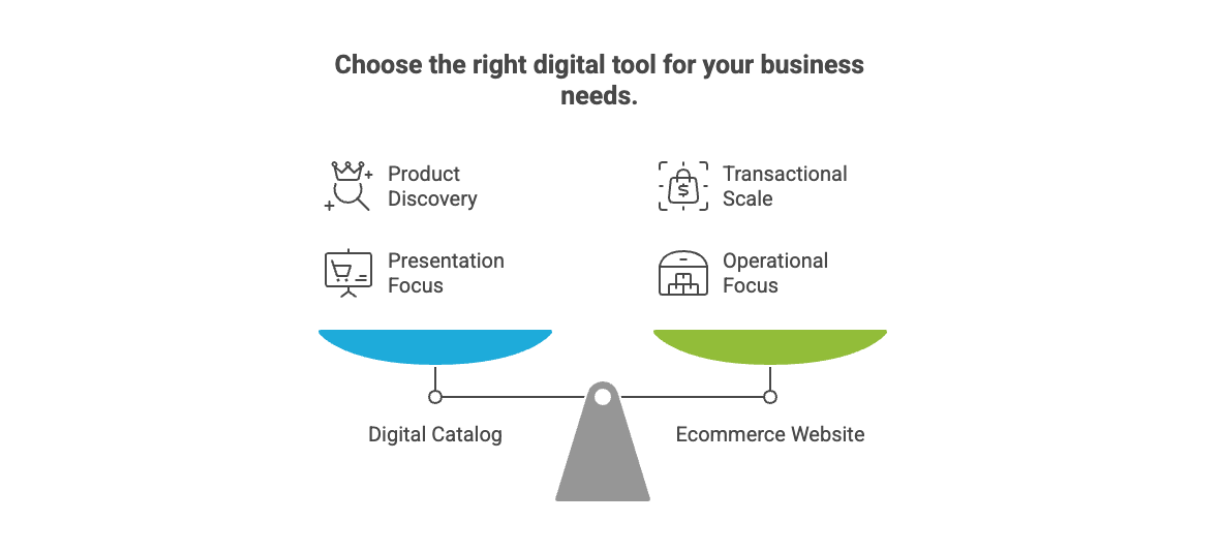
The confusion is understandable. Both show products online. Both can generate sales. Both are “digital”. But they are built for very different jobs. A digital catalog is designed for discovery and product presentation. An ecommerce website is designed for transactions and operational scale. They’re not the same thing. And more importantly, they’re not enemies.
Let’s break this down clearly.
What Is a Digital Catalog (Really)?
A digital catalog is an online, interactive product showcase. If you want a deeper understanding of what a digital catalog is before this comparison, that context will make the trade-offs clearer.
It focuses on:
- Browsing
- Inspiration
- Visual storytelling
- Organized product discovery
It usually opens through a link. Customers scroll, search, and explore. Sometimes they request a quote. Sometimes they click through to order.
It behaves more like a digital brochure or lookbook than a checkout system.
In India, digital catalogs are heavily used by:
- Fashion sellers
- Furniture and décor brands
- Wholesalers
- Jewelry businesses
- Instagram and WhatsApp-first sellers
- B2B distributors
Fashion is where this shift is most visible the digital catalog for fashion brands use case shows exactly why discovery and transaction need to be treated as two separate layers.
Its job is simple:
Help customers see what you offer — clearly and beautifully.
What Is an Ecommerce Website?
An ecommerce website is a full transactional system.
It includes:
- Product pages
- Shopping cart
- Payment gateway
- Order management
- Shipping integrations
- Customer accounts
- Real-time inventory
Its purpose is different. It’s not just showing products.
It’s built to process payments securely and handle operations at scale.
Platforms like Shopify, Magento, WooCommerce, and others fall into this category.
If your goal is 24/7 automated selling without human involvement, you need ecommerce infrastructure.
The Real Strategic Difference
Here’s where most businesses misunderstand the conversation.
A digital catalog attracts attention. An ecommerce website completes the purchase. One inspires. The other executes.
In performance marketing terms:
Digital Catalog = Top & Mid Funnel (Discovery + Consideration)
Ecommerce Website = Bottom Funnel (Conversion + Fulfillment)
That’s why asking “Which one is better?” is often the wrong question.
The better question is:
At what stage of growth does each one make sense for your business?
When a Digital Catalog Makes More Sense
A digital catalog becomes powerful when:
You sell visually-driven products
You rely on WhatsApp or Instagram conversations
You want customers to browse before committing
You operate in B2B or wholesale where quotes are common
You want lower technical complexity
In India, especially outside metro cities, many customers still prefer:
- Asking questions
- Negotiating
- Confirming on chat
- Paying via UPI
A heavy ecommerce website sometimes creates friction in these markets.
A digital catalog keeps the experience lighter and more conversational. And that matters more than most sellers realise. It's the same reason why small shops lose WhatsApp orders has less to do with pricing and more to do with friction.
When an Ecommerce Website Is Necessary
An ecommerce website is essential when:
You want fully automated checkout
You manage high daily order volumes
You need real-time inventory control
You require customer accounts and order history
You run serious performance ads at scale
If you’re handling thousands of SKUs and hundreds of daily transactions, ecommerce infrastructure isn’t optional. It’s operational insurance.
The 2026 Reality: Hybrid Models Win
The smartest brands are not choosing one. They’re combining both.
A common high-performing flow looks like this:
Customer discovers product through:
- Social media
- Ads
They browse via:
- A digital catalog (inspiring, clean, distraction-free)
When ready:
- They move to a checkout system
- Or confirm via WhatsApp
- Or complete purchase on website
This hybrid approach consistently performs better because it respects how customers actually behave.
Data shows:
- Nearly half of online visitors are browsing, not searching
- Catalog-driven traffic spends significantly more time engaging
- Catalog-assisted journeys often convert higher than pure search-based visits
Ecommerce alone assumes intent. Catalogs build intent. That difference matters.
So Where Does SellEzzy Fit In?
SellEzzy doesn't position itself as a replacement for ecommerce platforms. For a broader look at where it sits relative to other tools, the best digital catalog software in India comparison maps the full landscape.
And it’s not trying to be a heavy enterprise PIM either.
It sits in a middle layer that many Indian businesses actually need:
- A structured digital catalog
- One shareable link
- WhatsApp-connected order flow
- Real-time updates
- Analytics visibility
- Add-to-cart functionality that sends structured orders back to chat
For businesses that:
- Sell primarily through WhatsApp
- Don’t want to manage a full ecommerce stack
- Or want a lighter discovery layer before checkout
A system like this becomes practical.
It’s not about replacing ecommerce.
It’s about reducing friction before the transaction happens. For some brands, it becomes the main selling system. For others, it becomes the discovery engine that feeds into ecommerce. That’s the nuance.
Cost & Complexity Consideration
Ecommerce websites involve:
- Hosting
- Security
- Payment gateway fees
- Theme customization
- App ecosystem management
- Technical upkeep
Digital catalogs typically involve:
- Lower technical maintenance
- Faster setup
- Less operational overhead
- Easier content updates
The decision often depends less on “features” and more on:
- Operational readiness
- Internal tech capability
- Customer buying behavior
Industry Examples
Fashion & Apparel
Visual storytelling is critical. Catalog + ecommerce works best.
Luxury & Jewelry
Long decision cycles. Catalog builds trust before checkout.
Food & FMCG
Higher purchase intent. Ecommerce may dominate.
B2B & Wholesale
Catalog-first approach with quote or structured order flow is often more natural.
Home & Furniture
Room inspiration works better in catalog format before checkout.
There isn’t a universal answer. There is only contextual strategy.
The Big Mistake Businesses Make
The biggest mistake is treating this as a binary decision. Digital catalog and ecommerce website are not competitors. They are layers of the same journey.
One attracts.
One converts.
Together, they create flow.
Ignoring one side either limits inspiration or limits transaction capability.
Final Perspective (2026 View)
If you’re just starting and need revenue automation: Start with ecommerce.
If you’re WhatsApp-first or conversation-led: Start with a structured digital catalog.
If you’re scaling: Use both intelligently.
The future isn’t catalog vs ecommerce. It’s integration quality.
The brands that win in 2026 are the ones that:
- Remove friction
- Respect browsing behavior
- Offer structured transactions
- And build systems that support both discovery and decision
That’s where growth happens.
Frequently Asked Questions About Digital Catalog vs Ecommerce Website
1. What is the difference between a digital catalog and an ecommerce website?
A digital catalog focuses on product discovery and presentation. It showcases products in a visual, curated format to inspire browsing.
An ecommerce website is built for transactions. It includes a shopping cart, payment gateway, and order management system to complete purchases.
2. Can a digital catalog process payments?
No. A standard digital catalog does not process payments directly. It usually links to a checkout page or ecommerce platform where transactions are completed.
3. Which is better: digital catalog or ecommerce website?
They serve different purposes. A digital catalog improves discovery and engagement, while an ecommerce website enables secure transactions. Most modern brands use both together for maximum impact.
4. Do small businesses need an ecommerce website if they use a digital catalog?
It depends on their sales model. Businesses selling through WhatsApp or direct orders may use a digital catalog as their main discovery layer. However, if they want automated checkout and order management, an ecommerce website becomes important.
5. How does a digital catalog improve conversion rates?
Digital catalogs increase engagement and help customers visualize complete product combinations. This reduces friction, improves buying confidence, and can increase average order value.
6. Can digital catalogs work for B2B businesses?
Yes. Many wholesalers and manufacturers use digital catalogs to showcase products and collect inquiries before final pricing or negotiation happens.
7. Should I choose one or use both?
The strongest strategy in 2026 is hybrid. Use a digital catalog for inspiration and discovery, and an ecommerce website for checkout and operational management.